



Europe’s competitiveness test is no longer about money, but capability
Tuesday, 30 June 2026
Europe has rediscovered industrial policy. After years in which the phrase itself seemed to belong to another economic era, governments are once again talking about strategic sectors, supply chains, critical technologies, economic security and the need to compete in a much tougher global environment.
But the return of industrial policy raises a more difficult question: can Europe turn its new language of competitiveness into real industrial capability?
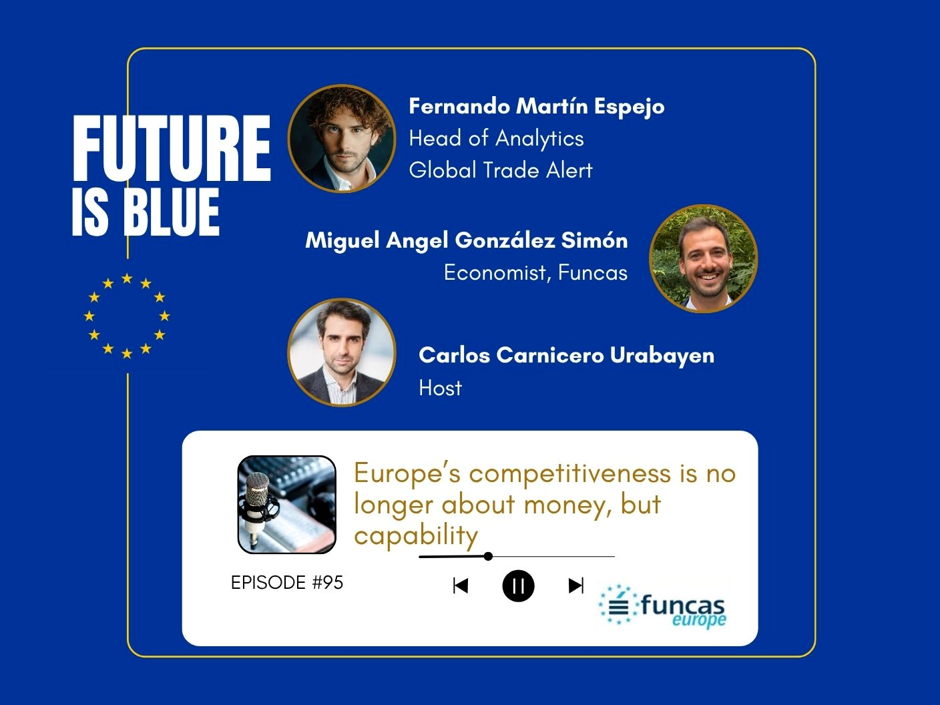
That was the central issue discussed in the latest episode of Future is Blue, with Fernando Martín Espejo, who leads the analytics unit at Global Trade Alert, and Miguel Ángel González Simón, economist at Funcas. The conversation moved beyond the familiar diagnosis that Europe is falling behind China and the United States. The deeper question is whether Europe is building the conditions that allow firms to invest, scale and compete — or whether it is simply reacting to strategies designed elsewhere.
[Listen to the episode here]
A reactive Europe?
For Fernando Martín, Europe’s approach has too often been reactive. The United States began to use trade and industrial policy in pursuit of national security objectives years before the EU fully absorbed the implications of this shift. China, meanwhile, has used scale, coordination and state direction to build strong positions in sectors now central to the global economy.
Europe has not been absent from this transformation. On green policy, it has been a leader, using regulation and other instruments to support the low-carbon transition. But Martín argued that the essential problem is not whether Europe moved first or later. It is whether it has made the right internal diagnosis.
“The missing question is the ‘so what’,” he said. The issue, in his view, is not simply whether Europe is copying the US or China, but whether it understands its own domestic capabilities, constraints and bottlenecks. Without that introspection, policy risks becoming a sequence of responses rather than a coherent strategy.
That matters because similar policy instruments can produce very different outcomes. Martín pointed to the contrast between the US and Europe after the adoption of large-scale industrial measures. If two jurisdictions use comparable tools but investment responds differently, the explanation cannot be found in the policy label alone. It must be found in the fundamentals.
The investment gap is also a fragmentation gap
Miguel Ángel González agreed that Europe’s competitiveness debate often starts from an incomplete diagnosis. The standard view is that Europe does not invest enough. That is true, he argued, but too broad to be useful.
The real weakness is concentrated in high-frontier, intangible-intensive activities. Intellectual property is the clearest example. Europe spends around 4 per cent of GDP in this area, compared with closer to 7 per cent in the United States. But the difference is not only quantitative. Europe also directs less of that spending towards the highest-frontier activities.
For González, this changes the nature of the problem. These activities require continental scale, long horizons and a tolerance for uncertain returns. They also demand private investment. The issue is not only whether public money is available, but whether private capital sees a credible business case.
“The reason private capital does not fund those activities in Europe is not that finance is scarce or too expensive,” he said. “It is that the market is fragmented.” If the real economy remains fragmented, projects do not become bankable, even if capital markets deepen. In his words, the EU’s Competitiveness Compass “asks a European question, and answers it mostly with national and financial tools”.
“What is missing,” he argued, “is a European capacity to create scale and to share risk.”
[Listen to the episode here]
Subsidies do not build industries by themselves
The discussion then turned to implementation. Across the US, China and Europe, policymakers now speak a similar language: resilience, supply chains, strategic technologies, sovereignty. But spending is not the same as building.
Martín put it bluntly: “Money buys announcements, but only the fundamentals build capabilities.” Subsidies can help, but they work only if they improve the expected return for firms. Policymakers too often assume that once public money is placed on the table, companies will take it and investment will follow. The reality is more complex.
He pointed to cases where generous public support did not overcome structural headwinds such as high energy costs, policy uncertainty or weak demand. A subsidy may reduce part of the cost, but it cannot by itself fix an uncompetitive business environment.
González made a similar point from a European perspective. The key is whether policy hits the binding constraint. If the constraint is risk and scale, cheaper capital alone will not be enough. Europe needs instruments that encourage private investors to enter projects they would otherwise avoid: guarantees, first-loss positions, common standards and aggregated demand at continental level.
“For me, what matters is the type of instrument, not only the size of the envelope,” he said.
Trade: security matters, but openness still matters too
Europe’s other great economic instrument is trade. But trade policy is also being reshaped by security concerns, raw materials, technology controls and geopolitical rivalry. The old view of trade agreements as purely market-opening tools no longer captures the world in which European firms operate.
Yet Martín warned against replacing one simplification with another. The choice between commerce and security, he argued, is a false one. Globalisation based solely on efficiency has ended. Governments now treat firms and supply chains as strategic assets. But that does not mean openness has lost its value.
“We tend to forget that open markets are also a synonym of resilience,” he said. Markets reroute, suppliers substitute and consumers adapt. Closing borders in the name of security can create the fragility it claims to prevent.
Agreements are only the first step
González added that EU trade agreements have delivered, but not equally across member states. Spain offers an interesting case. Looking at goods exports product by product and market by market around the entry into force of trade agreements, Spanish exports accelerated significantly after five years, outperforming the rest of the EU in the pattern he described.
But the composition matters. Where partners are close, or where Spain has historical and linguistic links, growth tends to come from selling more of what Spain already exported. In more distant markets with no previous link, such as Korea or Japan, the gains come more from new products. That is the harder path, because entry costs are higher.
The lesson is that signing an agreement is necessary, but insufficient. Whether it delivers depends on the depth of the agreement and whether firms actually use it. Trade policy can open a door. It cannot by itself ensure that companies walk through it.
The 2030 test
The episode closed with a forward-looking question: by 2030, what would show that Europe had turned this moment into real competitive capability?
For Martín, the test lies in whether Europe has addressed the fundamentals already identified in major competitiveness debates: an integrated energy market, Capital Markets Union and more effective decision-making in key areas. The point is not to produce ever more ambitious plans, but to fix the bottlenecks that are already known.
González proposed another test: Europe’s export basket. “Not how big it is, but what is in it,” he said. By 2030, the question should be whether European firms are selling new products in markets where they had no historical advantage and had to win on capability.
That is perhaps the clearest measure of success. Europe does not lack strategies, funds or declarations of intent. The question is whether it can create the scale, risk-sharing mechanisms and competitive conditions that allow firms to turn policy ambition into productive strength.
In a more hostile global economy, Europe’s challenge is not simply to spend more. It is to build better.
[Listen to the episode here]
Carlos Carnicero Urabayen