



Can Europe achieve the unity it needs in a fragmenting world?
Monday, 26 October 2026
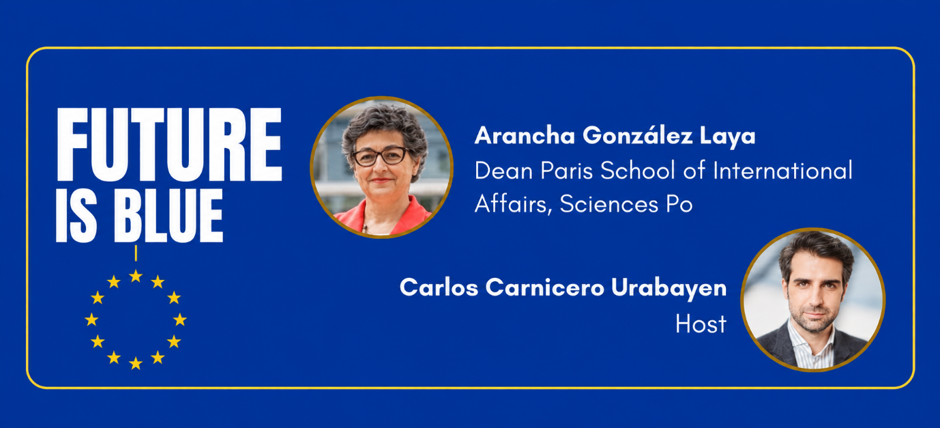
Europe’s challenge is not a shortage of ideas on what needs to do in a more volatile and fragmented world. It is finding the political will to act on them. For Arancha González Laya, the answer lies in the ability of European governments to build agreements that make closer integration possible and to persuade citizens that it serves their interests.
“We are over diagnosed in Europe,” she says in the latest episode of Future is Blue, the European economic affairs podcast promoted by Funcas. The solutions, in her view, are on the table, and what is missing is the political work needed to put them into practice.
[Listen to the podcast here]
Our conversation followed an event on geopolitics and competitiveness at Funcas headquarters in Madrid, where González Laya, Spain’s former foreign minister and Dean of the Paris School of International Affairs at Sciences Po, joined Funcas Europe’s director Raymond Torres. The short interview returns to some of the discussion’s central questions: how Europe can shape its future, overcome its internal divisions and adapt to changing patterns of global trade.
Turning reforms into a political bargain
“We have a choice,” González Laya says in the podcast. Unlike countries with fewer resources or less economic weight, Europe has options, and the challenge is how to invest the political capital required to exercise them.
Her proposal is to change the way reforms are negotiated. Energy, capital markets, technology and the single market are too often discussed separately. Yet governments’ interests cut across these areas. A concession on one issue may become politically possible if it delivers a gain on another.
Instead of seeking agreement within each policy silo, she advocates broader packages. Governments need to know what they are contributing, but also what they can take home to their voters. This is not about inventing a new European method. It is about applying the familiar logic of compromise across a wider agenda.
At the Madrid event, she added a concrete priority: capital-market integration. In her assessment, progress here is particularly urgent because mobilising European savings would help finance investment across the continent. She also saw scope for willing countries to advance together, while warning that such coalitions need sufficient economic weight to make a difference.
[Listen to the podcast here]
Making integration matter to citizens
Agreement among governments is only part of the task. González Laya describes a political contest between those who see greater European unity as the answer to insecurity and those who want powers returned to national capitals.
Her response is that national identity and European integration need not be opposing loyalties. In a world shaped by large powers, she argues, individual member states lack the scale to protect their interests effectively, including the largest European economies.
Pooling sovereignty can, in her view, make countries more sovereign in practice. Wherever formal power sits, sovereignty is measured by whether governments can protect what matters to their citizens.
Making that argument requires a different public conversation. “Maybe we stop talking macro, and maybe we start talking micro,” she suggests. Rather than relying on institutional language, political leaders should address the everyday concerns through which people judge prosperity and security.
For González Laya, “talking micro” means explaining the benefits of the EU and closer integration in concrete terms that resonate with citizens’ daily lives. She points to Europe’s longer life expectancy, lower infant mortality and homicide rates, and lower inequality compared with the United States as examples of what is worth protecting. While acknowledging unresolved problems such as access to housing, she argues that the case for greater unity must show how it can preserve and improve people’s quality of life.
Remaining open in a fragmenting world
On trade, González Laya challenges the idea that globalisation is simply going into reverse. “The world is not deglobalizing,” she says. “The world is re-wiring.” In her account, economic links remain, but their geography is changing under geopolitical pressure.
Europe’s response, she argues, should combine new trade opportunities abroad with deeper integration at home. She calls for more ambition in trade relationships with partners including Mercosur, India, Australia and the Philippines. At the same time, reducing internal barriers would strengthen Europe’s capacity to withstand external pressure.
The Madrid discussion extended this argument about openness and resilience to artificial intelligence. González Laya emphasised adoption: using AI to improve productivity in practical settings, from irrigation to detecting agricultural pests. She distinguished those opportunities from sensitive national-security applications, where she argues that Europe needs capabilities of its own. Strategic autonomy, in this account, does not require withdrawing from international exchange.
Across the event and our podcast conversation, her message is that Europe retains room to act. The open question is whether its leaders can use it to reach agreements, and turn them into a persuasive case to citizens.
Listen here the conversation with Arancha González Laya on Future is Blue.
Carlos Carnicero Urabayen