



What prevents action to reverse Europe’s competitiveness decline?
Tuesday, 22 September 2026
Europe no longer lacks diagnoses of its competitiveness problem. Weak productivity, insufficient investment, fragmented markets and the difficulty of scaling up European companies are by now familiar concerns. What Europe still lacks is a convincing way to turn that consensus into a strong reform momentum.
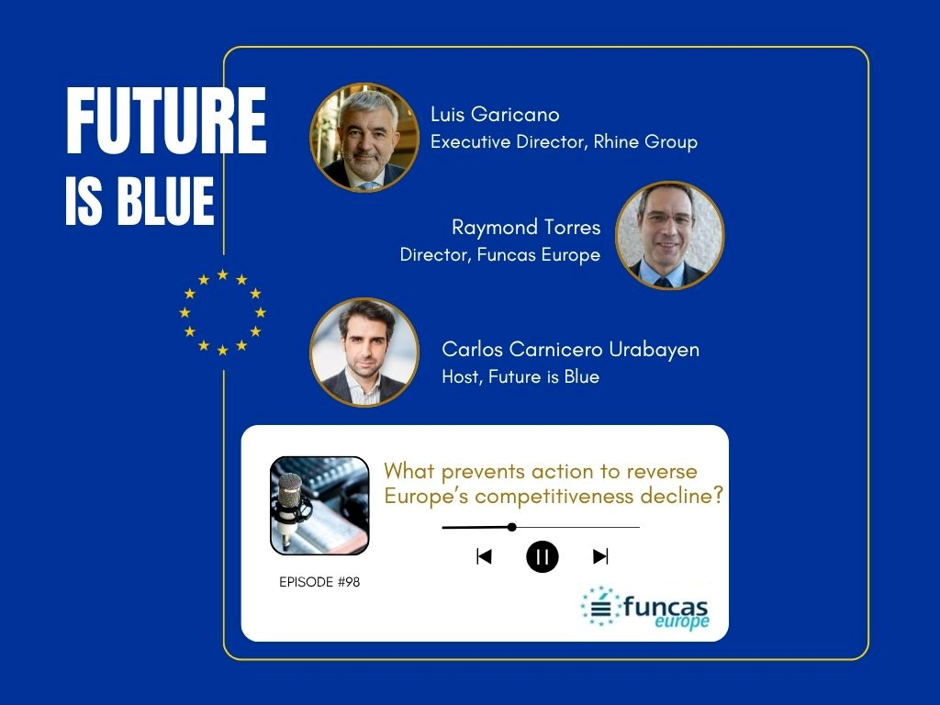
¿What are the causes of inaction and how to move forward? These issues are addressed in the latest episode of Future is Blue, with Luis Garicano, Professor of Public Policy at the London School of Economics and Executive Director of the recently launched Rhine Group, and Raymond Torres, Funcas Europe Director.
The discussion began with the Rhine Group itself. Mario Draghi, one of the initiative’s founders and co-chair, set out an extensive competitiveness agenda in his 2024 report. Two years later, Garicano warns on the consequences of lagging implementation and emphasises that the purpose of the Group is precisely “to try to help on that implementation”.
He claims that the Group’s distinctive strength lies in bringing together economists, scientists, entrepreneurs, business leaders and people with direct experience of policymaking. “The mix of all that means that we have perspectives that no other organisation in Europe has,” he said.
[You can access the full episode here].
The obstacles are both political and institutional
For Torres, Europe’s fundamental problem is not a shortage of proposals. The geopolitical environment has become more complicated since the Draghi and Letta reports, particularly with the return of Donald Trump and the much greater prominence of defence. But the deeper obstacle, he argued, is governance.
“The real issue is how to move forward,” Torres said, and in this sense, “the real cause, in my opinion, has to do with governance.”
Many reforms run into the difficulty of achieving unanimity or even a qualified majority. Torres therefore pointed to enhanced cooperation — allowing willing countries to move ahead without waiting for others — as one practical way to break the stalemate.
Garicano largely agreed. He was sceptical that member states will transfer much more power over taxation, fiscal policy or debt issuance to the European level. The more realistic route, he argued, is for smaller groups of countries to advance together, as Europe has done with projects ranging from Airbus to the euro.
“The possibility of some countries pushing forward with some measures is going to be the only way forward,” he said.
At the same time, Garicano argued that the European Commission should focus much more forcefully on an area where it already has substantial powers: the single market.
Europe saves — but does not invest enough at home
This matters directly for investment. Torres highlighted one of Europe’s persistent contradictions: the continent needs far more investment in energy, technology and the green transition, yet a significant share of European savings is invested elsewhere.
He argued that strengthening the single market is essential if Europe wants more of its own capital to finance growth at home. Removing barriers to cross-border investment and helping companies scale would not necessarily require large amounts of additional public money. Many changes are regulatory.
Garicano emphasised that the problem goes beyond the quantity of available capital. European companies still face powerful incentives to scale in the United States rather than across European markets.
“If you’re a startup, you prefer to start here, scale up in the US … and not to scale Denmark, Spain, Germany, because that’s very costly,” he said.
Public investment faces a different constraint. Garicano pointed to the growing weight of pensions and healthcare in national budgets, which leaves less room for education and future-oriented investment.
[You can access the full episode here].
The single market is far less complete than it looks
A striking part of the discussion concerned the gap between the legal idea of the single market and the reality faced by firms.
Garicano used the principle of mutual recognition — the idea that a product legally sold in one member state should generally be sellable in another — to illustrate how far practice can diverge from theory. National rules, additional regulatory requirements and slow enforcement can still make expansion prohibitively difficult for smaller companies.
He also argued that European harmonisation can sometimes add another regulatory layer without actually removing national ones. A company may therefore have to comply with both European and national requirements at the same time, rather than benefiting from a genuinely unified regime.
His conclusion was deliberately provocative: while Europe spends enormous political energy negotiating access to external markets, it has still not secured frictionless access to its own.
Some of the most useful competitiveness reforms, therefore, are reforms Europe can undertake itself.
Europe needs visible wins
The final part of the discussion focused on priorities. Torres warned that the political environment is becoming more difficult, with growing pressure to renationalise policies and increasing scepticism about European integration. “Europe needs some quick wins,” he said.
Those wins, he argued, need to be visible to citizens. He mentioned satellite communications, energy interconnections and initiatives that could channel household savings into European investment.
Garicano shared the sense of urgency. He pointed to artificial intelligence as one area where Europe risks falling decisively behind the United States, with consequences for research, productivity and future industries.
“AI would be a priority for me,” he said, alongside a deeper single market and a European regime that would make it easier for new companies to register, operate and scale across borders.
The broader message from both speakers was that Europe does not need another period of diagnosis. It needs implementation, experimentation and evidence that reform can work.
The key challenge is whether governments and institutions can act before economic underperformance feeds further political fragmentation.
[You can access the full episode here].
Carlos Carnicero Urabayen
Future is Blue host