



UK-EU relations: Brexit’s old trade-offs in a harsher world
Monday, 20 July 2026
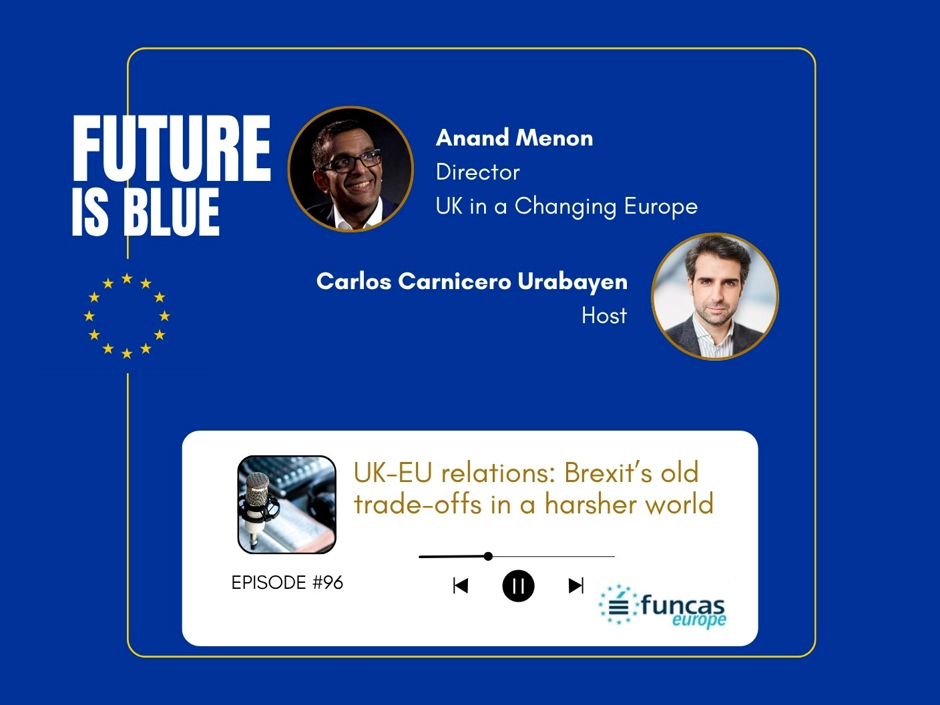
Ten years after the Brexit referendum, the UK and the European Union are again trying to place their relationship on more pragmatic ground. After years of legal disputes, symbolic clashes and mistrust, the conversation is now more businesslike: trade frictions, regulation, energy, defence, youth mobility and security.
But Anand Menon, Professor of European Politics and Foreign Affairs at King’s College London and Director of UK in a Changing Europe, is cautious about how far the reset can go. Speaking on the Future is Blue podcast, he argued that Brexit’s central dilemma has not disappeared: Britain wants easier access to its largest trading partner without giving up the political autonomy that Brexit was designed to recover.
[You can listen to the podcast episode here].
A more difficult world for Brexit
One paradox of leaving the EU, Menon said, is that “when you’re outside the European Union, you almost have to spend more time thinking about it and worrying about it than when you’re inside.”
What has changed is the international context. In 2016, the optimistic case for Brexit assumed Britain could ride globalisation, keep trading with Europe, strike new deals worldwide and shelter under the American security guarantee. Since then, globalisation has slowed, trade barriers have risen and the American guarantee looks less certain. For Menon, the conclusion is clear: “The world is a far less conducive place to doing Brexit than it was in 2016.”
Better relations, limited results
The change in atmosphere is real. Menon credited Rishi Sunak’s government, particularly after the Windsor Framework, with beginning the improvement. Keir Starmer has continued it in his dealings with EU leaders and national governments.
But tone has not yet transformed the relationship. Agreements have been reached on fisheries and on Britain’s association with European research programmes. Talks on electricity markets, emissions trading, agriculture and youth mobility remain unfinished, and Menon warned against assuming they will succeed, noting reports of difficulties in the negotiations. Agreement, he said, “is not a foregone conclusion.”
The difficulty is structural. The EU negotiates in its own interests and is wary of giving a former member state selective access to membership benefits. Even if the current talks go well, Menon argued, Britain faces a harder choice: revisit its red lines on the Single Market, customs union and freedom of movement, or accept a relationship close to today’s.
“I think the EU is done with giving us carve-outs of the Single Market,” he said.
[You can listen to the podcast episode here].
The autonomy-access trade-off
For Menon, Brexit was always a trade-off between market access and political autonomy — one now becoming clearer to voters and policymakers, although, as he put it, “10 years too late”. Labour’s position reflects the tension: it wants to stay outside the Single Market and customs union while reducing trade barriers.
“You can’t actually tear down barriers to trade as long as you’re respecting those red lines,” he said.
The reset is not irrelevant: practical improvements could reduce frictions. But the economic upside is likely to be modest while the UK stays outside the main structures of European economic integration. Menon contrasted estimates that put Brexit’s cost at around 8% of GDP with official projections suggesting the reset would recover only a small fraction of that over many years.
Security cooperation has its own logic
Defence offers a stronger strategic case. Britain remains a major European military power, and the war in Ukraine has reinforced the need for coordination. Yet Menon cautioned against assuming this must always happen through EU institutions.
“The European Union isn’t the be-all and end-all when it comes to security,” he said. Britain can work with European partners through NATO, bilateral agreements, coalitions of the willing and specific defence projects.
Still, there is a tension inside the EU. On operational security, “Europe” is defined broadly, including the UK, Ukraine and potentially Canada. But on procurement, financing and industrial policy, some member states take a narrower view — and attach a high price to British access.
Brussels has not forgotten the past
One concern in Brussels is that any deal with this British government could be reversed by a future one. Menon acknowledged the issue, but warned against treating it as uniquely British. The risk that a future government reverses what its predecessor signed, he said, “goes by the name of democracy.”
There is also a wider European calculation. Norway and Switzerland are watching closely for any concession to Britain that has been denied to them. Inside the EU, populist parties may no longer call for exit, but many argue for a looser Union, a weaker Commission and more flexibility in applying the rules — arguments a generous deal outside membership could strengthen.
Public opinion is moving, but not decisively
British opinion has become more favourable towards closer ties, but Menon warned that support can soften once voters face the conditions attached. Rejoining attracts broad backing in principle; once the debate turns to the euro, free movement or EU rules, the numbers become less certain.
The destination is unclear. Menon dismissed a sector-by-sector model as unrealistic — the UK may want “a little bit of chemicals, a little bit of car manufacturing”, but the EU is unlikely to offer it — while Norwegian- or Swiss-style models imply substantial rule-taking. His most likely scenario is modest: “some variant of where we are today, which is essentially TCA+” — a trade and cooperation agreement with deeper security cooperation, much of it outside the EU framework.
[You can listen to the podcast episode here].
Geography still matters
Menon’s final message was that both sides should not lose sight of the strategic reality they share: they may disagree over institutional rules, but remain bound by geography, economics and security.
“Geography is a potent force in global politics,” he said. “Geography means we share essential geopolitical and geoeconomic interests.”
The challenge is to apply more creativity without pretending that Brexit’s old trade-offs have disappeared. The reset is unlikely to transform radically UK-EU relations, but in a more hostile international environment even limited improvements carry strategic weight for both sides.
[You can listen to the podcast episode here].
Carlos Carnicero Urabayen