



The EU’s next budget: from redistribution to competitiveness
Thursday, 28 May 2026
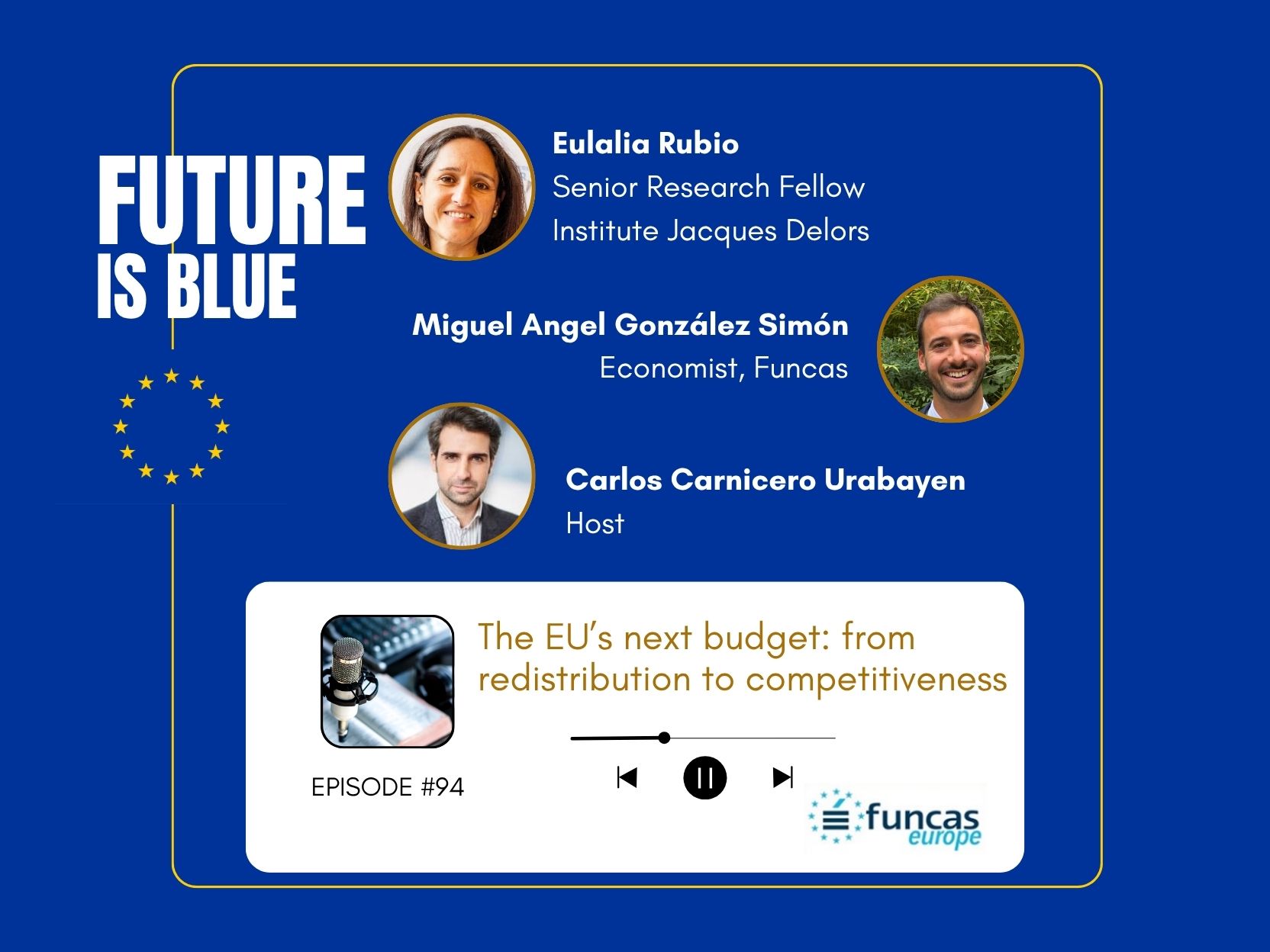
Europe’s next long-term budget is becoming a debate not only about resources, but about the kind of political and economic actor the European Union wants to become. At a moment of geopolitical instability, industrial competition and growing pressure on public finances, the European Commission’s proposal for the 2028–2034 Multiannual Financial Framework (MFF) is attempting something more ambitious than a traditional allocation of resources among Member States.
That was one of the central conclusions of the latest episode of Future is Blue, featuring Eulalia Rubio, Senior Research Fellow for Economic Affairs at the Jacques Delors Institute, and Miguel Ángel González, economist at Funcas. The discussion explored how the Commission’s proposal could reshape the governance of the EU budget, the tensions between competitiveness and cohesion, and the lessons Europe should draw from the implementation of Next Generation EU.
[You can listen to the podcast here].
A more political and flexible budget
At first glance, the proposal may not seem revolutionary. The overall size of the EU budget remains broadly unchanged, hovering around 1 per cent of EU GDP. But according to Rubio, the real transformation lies elsewhere.
“What is really different this time,” she argued, “is the fact that the Commission proposed a different architecture and a different governance, a different way of planning and implementing EU funds.”
For Rubio, this marks the most significant shift in the EU budgetary framework since Jacques Delors introduced the modern multiannual system in the late 1980s. The Commission is proposing a structure that is less rigid, more centralised in some areas, and above all more flexible — a recognition that Europe now operates in a world of repeated crises and unpredictable shocks.
The traditional logic of defining detailed spending priorities seven years in advance increasingly clashes with geopolitical reality. Europe started to negotiate its previous long-term budget before the pandemic, before Russia’s invasion of Ukraine and before defence and industrial policy returned to the centre of European politics.
“It is very difficult to set up one multiannual EU budget for 2028–2034 in the current situation,” Rubio said. “We are in the middle of deep uncertainty and a lot of changes happening.”
That explains why flexibility has become one of the central themes of the debate. Rubio warned that one of the biggest risks during negotiations will be pressure from Member States to reintroduce rigid pre-allocation mechanisms and greater predictability at the expense of adaptability.
[You can listen to the podcast here].
The competitiveness-cohesion dilemma
The Commission’s proposal is also heavily shaped by the debate on European competitiveness that has intensified since the publication of the Draghi report. One of the most important innovations is the simplification of the budget structure into fewer and larger spending instruments, including a major competitiveness fund focused on strategic sectors and technologies.
But that shift creates political tensions of its own.
The proposal would reduce the share of spending devoted to cohesion policy and agriculture from roughly 60 per cent to 40 per cent of the budget. While the Commission argues that greater integration between programmes can generate synergies, poorer member States are already pushing to ensure that geographical balance remains embedded in the new competitiveness instruments.
For Rubio, this reveals a deeper unresolved question inside the European project: how to combine the push for global competitiveness with Europe’s traditional commitment to territorial cohesion.
“We want to compete with the US, we want to compete with China,” she said, “but we do not want to replicate the model of growth that is highly unequal.”
The danger, she warned, is that Member States could gradually dilute the strategic logic of the new competitiveness instruments by introducing geographical quotas and territorial redistribution criteria.
At the same time, Rubio argued that the current cohesion model also suffers from rigidities and inefficiencies, and that the new framework creates an opportunity to rethink how cohesion policy actually works in practice.
From absorption to transformation
If Rubio focused on the architecture of the proposal, Miguel Ángel González concentrated on a different challenge: implementation.
Drawing on Spain’s experience with Next Generation EU funds, González argued that the key issue for the next MFF is not simply how much money Europe mobilises, but whether national administrations and local structures can actually translate those resources into productive investment.
“The size of the budget is, in practice, a stress test on administrative capacity,” he stressed. “A bigger envelope does not move the dial proportionally if the bottleneck is downstream.”
Spain’s experience illustrates both the strengths and limitations of the recovery programme. According to Funcas estimates, Next Generation EU explained between 10 and 14 per cent of Spain’s annual real GDP growth between 2021 and 2025.
But González drew a sharp distinction between spending money and generating structural transformation.
“Absorbing a budget and transforming an economy are not the same exercise,” he said.
While Spain performed relatively well in committing and distributing funds, business investment remained below pre-pandemic levels in real terms at the end of 2025. The benefits were also concentrated in a relatively small number of sectors and larger firms.
One of the key lessons, González noted, is that the main obstacle for firms is often not the cost of financing, but uncertainty over profitability and risk.
“What moves the needle may be acting on risk,” he said, pointing to instruments such as guarantees and participative loans as potentially more effective tools for the next MFF.
He also argued that future EU instruments should focus more systematically on additionality — ensuring that EU money generates investment that would not otherwise happen — and on strengthening administrative capacity at regional and local level.
A test of Europe’s strategic capacity
Ultimately, both guests converged on a similar conclusion: the success of the next MFF will not be measured primarily by absorption rates or headline spending figures.
For Rubio, one important test will be whether the EU budget becomes capable of reacting more quickly and politically to future crises.
“What we have seen in the past is that each time it has been very difficult to readjust our spending,” she argued.
She also suggested that a more flexible system could help “repoliticise” the EU budget by giving the annual budget process greater political relevance and strengthening the role of the European Parliament in shaping spending priorities.
For González, the real benchmark is whether the budget changes the trajectory of the European economy itself.
“If in 2030 or 2031, the conversation has moved from how much was spent to what changed in the economy because of it,” he argued, “I think we will know whether the next MFF has been a turning point.”
The negotiations ahead will inevitably revolve around national interests, institutional rivalries and political compromises. But beneath those familiar battles lies a more strategic question: whether Europe can adapt its budgetary model to a world that is becoming more fragmented, more competitive and considerably less predictable.
[You can listen to the podcast here].
Carlos Carnicero Urabayen
Host, Future is Blue