



Europe’s economy has learnt to absorb shocks. Can it become more dynamic and productive?
Tuesday, 1 September 2026
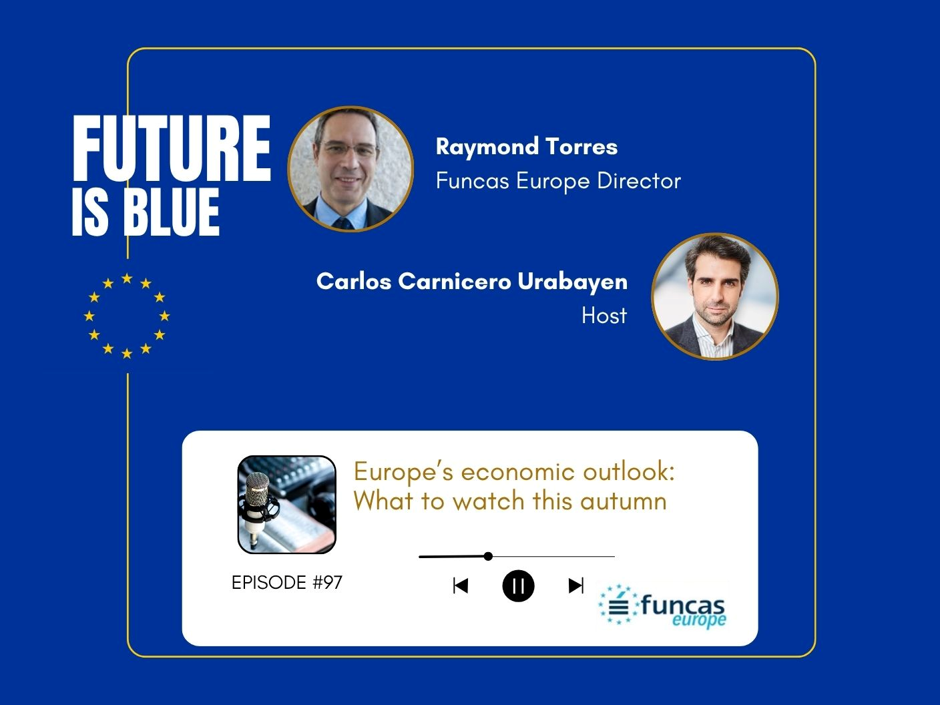
Europe enters the autumn in better economic shape than might have been expected only a few months ago. US protectionism, geopolitical instability and another energy shock have all tested an economy that was already struggling with weak productivity and investment.
Yet growth has held up, employment remains remarkably resilient and supply chains have adapted. However, while Europe has become better at absorbing shocks, the question is whether it can turn that resilience into something more durable.
This issue was at the heart of our latest Future is Blue podcast episode with Raymond Torres, Funcas Europe Director.
[You can access the full episode here].
Asked to score the European economy, Torres offered two very different numbers. “From the point of view of resilience, I would rank Europe an eight out of ten,” he said. But when it comes to economic dynamism, his assessment falls to “between four and five”.
The gap tells much of the story. Europe has weathered successive crises better than feared, but continues to lag when it comes to investment, productivity, adaptation to new technology and its capacity to exploit technological change.
The unexpected resilience of European households
One reason the economy has held up is household behaviour. Higher energy costs have eaten into purchasing power, but consumers have continued spending. Torres argues that households entered this period with relatively high savings and have been able to draw on them to cushion the impact of inflation.
“People have continued to consume. In other words, they have managed to absorb the loss of purchasing power,” he said.
Employment has provided another buffer. Even in economies that have barely grown, unemployment has moved surprisingly little. Companies have also responded faster than during previous crises, adjusting supply chains and bringing deliveries forward as geopolitical disruption affected maritime trade.
But some of that resilience will now be tested again. Energy markets remain an obvious vulnerability heading into the winter, while pressures over inflation and interest rates have returned.
[You can access the full episode here].
A strong labour market with a productivity problem
Europe’s labour market encapsulates the same contradiction. Torres agrees that it is currently stronger than the economy itself. Unemployment has barely moved in weak-growth countries such as Germany and Italy and has fallen significantly in Spain.
Part of this may reflect reforms carried out over many years. Demography matters too. With workers increasingly difficult to replace, companies may be reluctant to shed staff even when activity slows. “Enterprises are very much aware that it’s not so easy to find new talent, so they prefer to stick to existing staff,” Torres said.
That is good news for employment and consumption. But it also has another side. Labour productivity growth remains weak. Europe has managed to preserve jobs without yet finding a convincing way of generating substantially more output and real incomes from them.
Europe knows what to do — but cannot agree how to do it
On competitiveness, the problem is no longer a lack of diagnosis. The weaknesses are familiar: fragmented capital markets, insufficient investment, barriers within the single market and a persistent technology and productivity gap with the US and China.
“The diagnosis is quite clear,” Torres said. “Europe needs a combination of reforms and investment.” The harder question is execution.
Completing capital markets, for example, would require governments to give more supervisory and regulatory authority to the European level. Larger common investments would require more resources in the EU budget. Both run quickly into disagreements between member states.
Behind that difficulty lies a political problem. Weakening mainstream parties and the growing strength of forces sceptical of European integration make the transfer of powers to Brussels harder. Yet Torres warns of a vicious circle: the longer reforms are delayed, the more dissatisfaction with Europe’s economic performance can strengthen precisely those parties opposed to further integration.
[You can access the full episode here].
Spain’s advantage — and its housing constraint
Spain remains one of the striking exceptions to Europe’s generally weak growth performance. Torres sees a significant structural component to its outperformance. Relatively cheap energy and labour costs, together with substantially reduced private-sector indebtedness, have given Spain a competitive advantage, particularly as borrowing costs have risen.
Immigration has also played an important role. Funcas estimates that “almost half of economic growth reflects migration”, with foreign workers helping address shortages in construction, tourism and agriculture. That engine, however, has limits.
Spain’s shortage of housing increasingly constrains its ability to absorb additional workers. Unless housing supply improves, Torres argues, one of the factors supporting Spanish growth could become less powerful — while its broader competitive advantage may gradually erode.
What to watch this autumn
The most immediate risk is again energy. Torres singled out gas prices as the indicator he will monitor most closely. European reserves need replenishing before winter, while geopolitical disruption has already required the release of emergency energy stocks. Higher energy prices would feed into inflation and could complicate the European Central Bank’s decisions on interest rates.
Financial markets pose another uncertainty. Torres pointed to the possibility of an artificial intelligence bubble, whose timing and consequences are impossible to predict but which could have repercussions well beyond the US.
Europe therefore enters the autumn in an unusual position. It has survived tariffs, geopolitical disruption and energy turbulence considerably better than many expected. Germany may even be showing tentative signs of renewed investment, helped by greater spending on infrastructure and defence.
But survival is not the same as renewal. Europe’s recent performance suggests that its economy has become more adaptable. The task for the coming years is much harder: turning that resilience into investment, productivity and improved living standards.
[You can access the full episode here].
Carlos Carnicero Urabayen
Future is Blue host