



Iran shock tests Europe’s economy – and its strategic nerve
Thursday, 23 April 2026
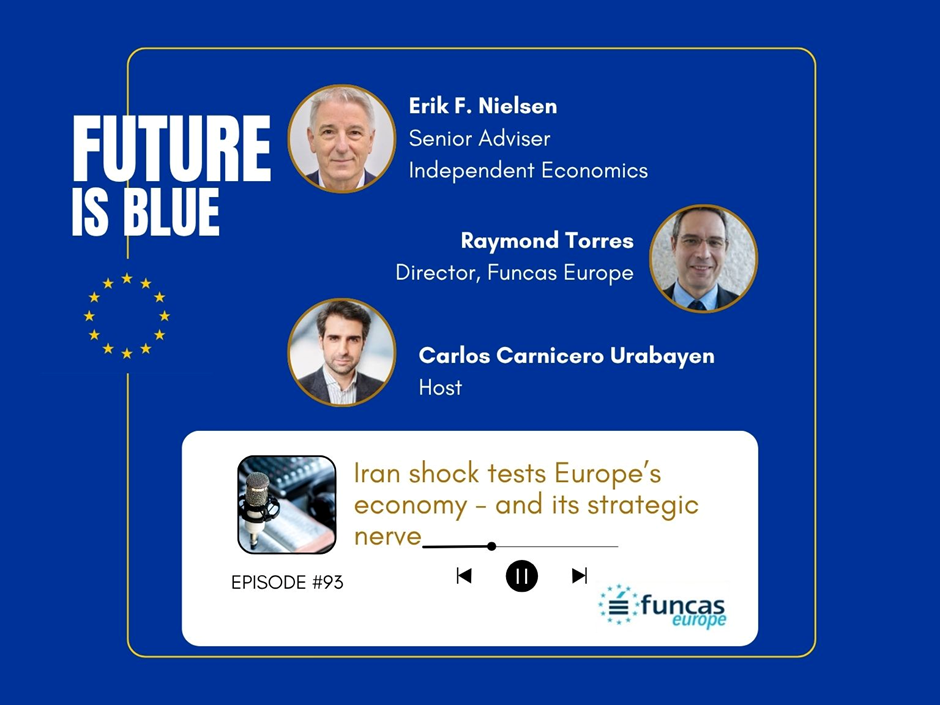
Europe is once again facing the return of geopolitical risk as an economic force. The war in Iran has created new uncertainty far beyond the Middle East, raising concerns over energy prices, inflation, growth and the resilience of an already fragile global order. But as Erik F. Nielsen and Raymond Torres argued in the latest episode of Future is Blue, the immediate economic impact may be only part of the story. The deeper challenge is Europe’s need to adapt to a world in which shocks are more frequent and the United States is no longer the stable strategic anchor it once was.
[You can listen to the podcast episode here].
For Europe, the timing is uncomfortable. Growth remains modest, industry is under pressure and inflation had only recently moved closer to the European Central Bank’s target. Yet Nielsen, Senior Adviser at Independent Economics and former Global Chief Economist at UniCredit, cautioned against overstating Europe’s fragility.
“It’s never a good time to be hit by a negative shock,” he said. “Europe is not in a particularly weak place. The shock is tremendous, but I would characterise it more as an uncertainty shock.”
A manageable oil shock – but a dangerous uncertain crisis
Higher oil prices, while painful, are not necessarily enough to derail the European economy. If oil were to remain around current elevated levels, Nielsen suggested, the impact would be “perfectly manageable”, even if unpleasant for vulnerable households and certain sectors. Growth could be reduced but not collapse.
The bigger issue is uncertainty. Europe is confronting not just another temporary disruption, but a new global regime marked by instability, repeated shocks and a less reliable United States. That uncertainty lowers potential growth because it affects investment, insurance, supply chains and confidence.
Raymond Torres, Funcas Europe Director, signalled the risks around the persistence of the shock. Damage to energy infrastructure and export facilities in the region could keep pressure on markets for longer than expected.
“I’m a little more worried about the size of the shock,” Torres said. “Not so much the level of prices now, which would be manageable, but the fact that so much capacity has been destroyed over the past few weeks means that the pressure will last longer than planned.”
Inflation returns, but not like in 2022
The inflationary consequences are likely to be different from the shock that followed Russia’s invasion of Ukraine. Europe is less exposed to Russian energy than it was in 2022, and the demand-side pressures that followed the pandemic have faded.
Nielsen argued that if energy prices stabilise, the effect on inflation should be largely temporary. Headline inflation would rise, and some costs would pass through to transport and other services, but this would not necessarily create a lasting inflation spiral.
Torres made a similar point. “We are in a different position from four years ago,” he said. “Whatever the size of the shock, the long-term inflation effects would be less. It will be more of a truly transitory impact, even though there may be some indirect effects on core inflation.”
That matters for the ECB. The central bank faces a familiar but uncomfortable dilemma: a shock that can raise inflation while weakening growth. Nielsen suggested that standard economic logic would argue for caution, especially if the price shock proves temporary. The ECB, however, will be watching inflation expectations closely.
Torres expected a limited reaction if core inflation shows signs of picking up, but he warned against assuming a dramatic tightening cycle. Markets may be overreacting by pricing in up to three interest rate increases. A more likely scenario, in his view, would be one or two at most, depending on how the shock develops.
No room for another blanket fiscal response
On fiscal policy, the message was clear: Europe should avoid repeating the broad support measures deployed during the previous energy crisis.
Nielsen argued that policymakers should resist the temptation to intervene every time a new shock hits. Governments can support those most exposed, but they should not try to insulate society completely from price signals. Higher energy prices, however painful, can also encourage efficiency and accelerate investment in alternative sources.
“What we learned from the last crisis is that one also has to be careful that you don’t reduce the effect of prices too permanently, because then you don’t get the efficiency gains,” Nielsen said.
Torres agreed, adding that many untargeted measures adopted during the previous crisis proved expensive and not very effective. Lower taxes, subsidies and generalised price support are politically attractive but difficult to reverse. Spain only recently unwound some measures introduced four years earlier.
The better approach is targeted support for vulnerable households and firms, combined with a faster energy transition. Torres pointed to Spain’s experience as an example of how investment in renewable energy sources can reduce exposure to global shocks. Energy interconnections and lower external dependence should therefore become part of Europe’s resilience strategy.
Strategic autonomy starts with priorities
The war reinforces the case for greater European self-reliance. Nielsen referred to the Draghi report as an important diagnosis, while warning that Europe must choose priorities rather than try to do everything at once. Energy, defence, technology and knowledge should be at the centre of the investment effort. The money exists, he argued, but Europe needs to mobilise its savings more effectively and create stronger incentives for investment at home.
Torres placed greater emphasis on political agreement. Before spending more, Europe needs a strategy so as not to dilute efforts. For instance, without coordination, higher defence expenditure could simply lead to waste and continued dependence on external suppliers.
For Torres, the priority is “to get agreement, at least among some European countries, on where to go”. In strategic areas, reinforced cooperation, or a coalition of willing countries may be more realistic than waiting for unanimity among all 27 member states.
Standing up to a changed United States
Europe should not treat the Trump administration as a passing disruption and simply wait for normality to return, argued Nielsen, as something more fundamental may be changing in the United States.
That has financial implications. Nielsen questioned why European institutions continue to treat US Treasuries almost as equivalent to European sovereign assets, despite America’s fiscal trajectory and increasingly confrontational politics.
Europe may struggle under unanimity rules, but coalitions of the willing can be very valuable for speeding up key reforms, as the euro itself demonstrated. Internally, Europe should deepen the single market and remove barriers to the mobility of savings. Externally, it should strengthen ties with like-minded partners such as Canada and Australia, argued Torres.
The war in Iran is therefore not only another geopolitical crisis. It is a stress test for Europe’s economic resilience, monetary policy, fiscal discipline and strategic ambition. The immediate concern is how to absorb the shock. The deeper question is whether Europe can use it to become more united, more self-reliant and better prepared for the unstable world ahead.
[You can listen to the podcast episode here].
Carlos Carnicero Urabayen Host, Future is Blue