


Europe’s trade stress test in 2026: coercion, alliances and the single market
Wednesday, 28 January 2026
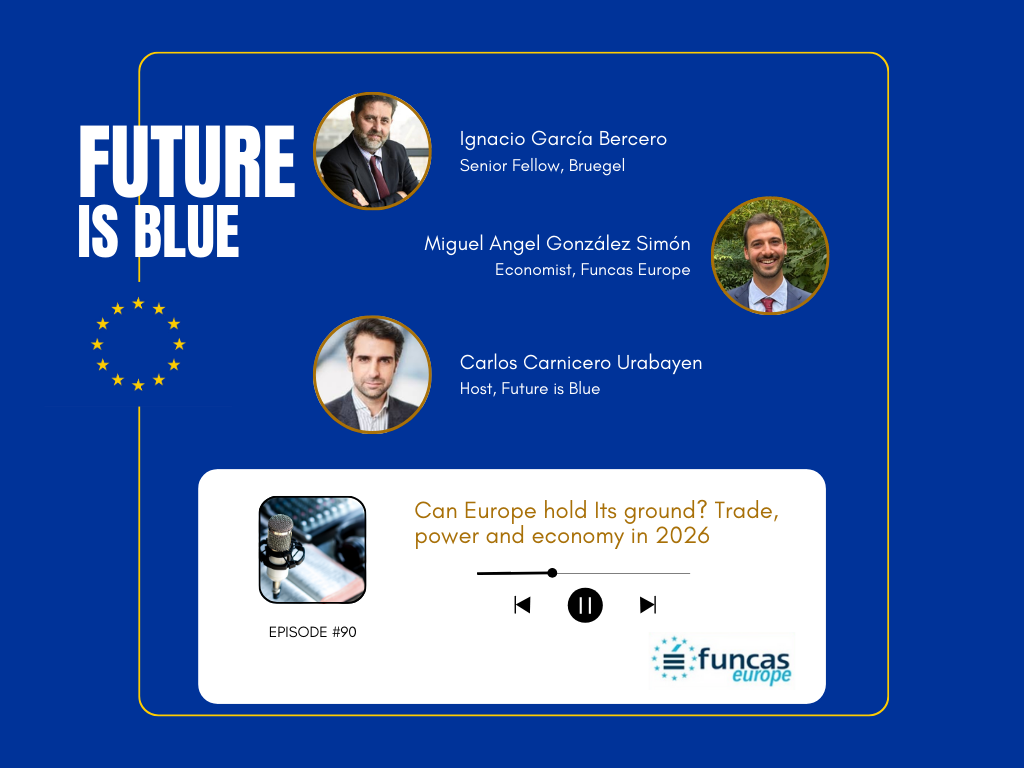
Trade sits at the intersection of Europe’s economic risks and its strategic opportunities. That was the starting point of the latest Future is Blue episode, where we spoke with Ignacio García Bercero, Bruegel Senior Fellow and former EU chief trade negotiator with the United States, and Miguel Ángel González-Simón, economist at Funcas.
The discussion comes amid a volatile start to 2026 in transatlantic relations — marked by renewed tariff threats, and the increasingly explicit use of trade as geopolitical leverage.
[You can access the podcast here].A fragile transatlantic «deal» — and a sharp turn
García Bercero recalled last year’s standoff, when Washington threatened tariffs of 30–50% on all EU exports. Negotiations ended in July with a political agreement setting a 15% tariff ceiling in exchange for the EU moving toward eliminating industrial duties. Because it is political rather than treaty-based, implementation requires approval from the Council and European Parliament.
That process was nearing its decisive moment when a new tariff threat emerged. President Trump announced targeted tariffs against some EU member states that had expressed solidarity with Denmark amid tensions over Greenland. For García Bercero, the episode illustrated «a U.S. administration that does not hesitate in actually threatening the use of tariffs for purely political, geopolitical objectives, in a way which is clearly coercive.»
He expects the EP to adopt the implementing regulation for the July deal now that the U.S. tariff threat has been withdrawn. But the EU needs to be ready to withstand future shocks through a provision of suspension of the Regulation in case of future action by the U.S. in breach of the July agreement, argued Garcia Bercero. Similarly, those circumstances should trigger activation of the 93bn retaliation list.
Europe’s toolbox: deterrence, speed and anti-coercion
What can the EU do when tariffs become a coercive weapon? García Bercero was direct: «I think we have all the tools that we need. What we need is the political will to be able to deploy them.»
The first line of defence is the retaliation package prepared last year — «a list that covered €93 billion of U.S. trade» with tariff rates from 10% to 30%, already adopted but suspended. The key is credible speed: if Washington breaches the political agreement signed last July, the EU must activate countermeasures rapidly.
The second pillar is the Anti-Coercion Instrument (ACI), adopted in 2023, which offers flexibility to respond to different kinds of pressure. García Bercero argued Europe needs both tools.
He also challenged the assumption that the U.S. always dominates escalation. «Contrary to what is often said, the United States does not have escalation dominance,» he argued — the U.S. is «highly dependent on trade with the European Union,» including inputs American firms cannot easily replace.
Resilience in 2025, but fragile foundations
González-Simón widened the lens to the economic picture at the end of 2025. «The biggest surprise was economic resilience, both globally and in Europe,» he said — but warned «it may have an expiration date.»
Much of that resilience was front-loaded as firms anticipated tariffs and brought forward investment and purchasing decisions, and the tariffs that materialised were lower than initially announced. Meanwhile, in the United States, growth was mainly driven by «massive investment in artificial intelligence».
He highlighted two trends. First, employment remained robust with historically low euro area unemployment — but weak productivity. «The European economy is growing by adding workers, and not by becoming more efficient.» If employment growth stabilises, Europe risks losing its main near-term growth engine.
Second, imports from China increased notably in 2025 while U.S. trade stayed stable, though sectoral exposure varies — in vehicles, for instance, shifts are already visible.
How the shocks transmit in 2026
González-Simón outlined three channels through which fragmentation could shape Europe’s economy. First, uncertainty — «the main obstacle to investment» in business surveys. «Investment decisions delayed today translate into lower productive capacity tomorrow.»
Second, global value chains. European manufacturing is deeply embedded in cross-border supply networks. He pointed to the «Second China shock,» which differs from the early-2000s version: «This one is about products that compete directly with Europe’s industrial strengths,» especially automotive.
Third, productivity: «More productive firms tend to be more export-oriented,» making them more exposed when trade becomes contested — depressing aggregate productivity growth, not only trade volumes.
Trade strategy for 2026: deals — and coalition building
García Bercero argued Europe must deepen partnerships with countries that still want open, rules-based trade. He singled out three priorities. Mercosur remains politically fraught after «a significant setback» in the European Parliament. India, where negotiations could soon conclude, would be «hugely significant» even if not as ambitious. And Indonesia, where the EU already concluded «a very important and ambitious trade agreement».
Beyond bilateralism, Europe should consolidate a broader coalition — including deeper cooperation with the Comprehensive and Progressive Agreement for Trans-Pacific Partnership (CPTPP) members — and explore «a common protocol of rules of origin» to link its trade agreements.
The Single Market as Europe’s anchor
González-Simón’s priority was inward strengthening. «If the external environment is fragmenting, Europe’s most valuable asset is its internal market, which is underused.» Europe’s 450 million consumers face cross-border barriers «higher here than between U.S. states.» The logic is not autarky but competitiveness: «strengthening the foundation that allows European firms to compete externally.»
He pointed to the Commission’s push on a Savings and Investment Union and plans for «EU Inc.» Yet the decisive variable is implementation. «If the world fragments, Europe must integrate.»
A political narrative — and an economic test
García Bercero returned to Europe’s hardest constraint: politics. The EU’s firm reaction to Greenland-related tariff threats was «very encouraging,» but fragile support for Mercosur revealed persistent divisions. Europe needs «the right political narrative» for outward engagement rather than «closing up.»
González-Simón offered a concrete test: private investment. «If uncertainty is the main channel, then the test is whether firms will start investing again.» By year-end, Europe should see «business investment growing above its recent trend.»
The episode’s message was clear: trade is no longer just economics — it is strategy, deterrence, alliances, and internal reform at once.
[You can access the podcast here].Carlos Carnicero Urabayen