


Europe’s end-of-year reckoning: Trump’s “sharp power”, China’s trade shock — and a 2026 test of political will
Tuesday, 23 December 2025
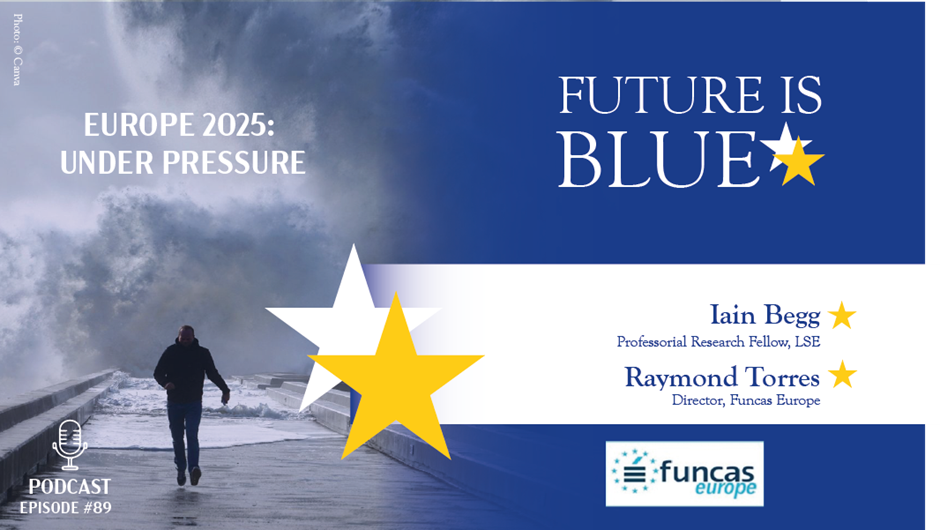
As 2025 draws to a close, Europe is confronting an uncomfortable reality: the external environment has changed faster than the EU’s ability to adapt. In a year shaped by the return of Donald Trump to the White House and by intensifying economic pressure from China, Iain Begg, Professorial Research Fellow at the London School of Economics, and Raymond Torres, Funcas Europe Director — converged on a clear diagnosis: Europe’s response has been largely defensive, and its internal reform agenda remains stuck, despite the many opportunities that a cohesive strategy would open up.
[You can access here the full podcast episode]Geopolitics has taken the place of multilateralism, while Europe’s political and institutional reflexes were built for an era in which trade, investment and diplomacy were anchored in rules and cooperation. That era, Torres argued, is fading fast.
“It is no longer international cooperation, but rather the asymmetric power between nations, which is the driving force now in international relations”, he said.
A second Trump presidency — but not a repeat
Begg argued that, unlike the first Trump administration, which he characterised as chaotic, the second has arrived with organisation and intent — and that makes its impact more immediate for allies and rivals alike.
“The biggest change is that the new Trump team came in with a clear plan about the things they were going to do,” Begg said. Now, he added, “what Trump decides is implemented with great force.”
For Europe, the implication is not just policy uncertainty, but a new operating logic in transatlantic relations. Trump’s worldview is “America first” filtered through deal-making, Begg said: “His view on everything is, how do I benefit from this? How does America benefit from this?”
This shift is part of a broader framework about how power is exercised. The transatlantic divide increasingly reflects different power styles: the US has traditionally relied on “hard power”, Europe has leaned more on “soft power”, but recent US policy has made growing use of what scholars have described as “sharp power.”
The concept, originally developed to describe how authoritarian states deploy economic and informational leverage to influence others, has gained renewed relevance in the transatlantic context. “There’s something in between… and that is sharp power,” Begg said — “using the economic might to coerce other countries into doing things in a way that they’ve not been used to.” In his view, “much of what Trump has done over the last 12 months has been this form of sharp power.”
Torres added historical perspective, pointing to the economist Albert Hirschman’s early work on the “power of nations” embedded in trade structures — and warning that coercive economic pressure can have destabilising consequences if it escalates. The hope, he said, is that this dynamic does not “lead to this kind of situation in the future.”
[You can access here the full podcast episode]China’s pressure: market closure and a widening imbalance
If Washington’s shift has been loud and visible, Europe’s friction with Beijing has been less spectacular but no less consequential. The pattern is clear: the Chinese market is becoming harder for Europeans to access at the same time that Chinese exports into Europe are surging.
“The Chinese market has entered a period of stagnation,” Torres said. “Imports of… European products have declined this year,” while “exports of China to Europe… have exploded,” leaving “a large deficit in the order of 200 billion euro per year.”
Begg added that long-run trends are now crystallising into political-economic shocks. “Medium and long-term trends from China are now coming to fruition,” he said, pointing to the automobile sector. “China is now the major global manufacturer of automobiles,” a position that “in the past was a German specialisation within Europe.”
That matters beyond Germany itself. Begg argued that German industry functions as the hub of Europe’s “hub-and-spoke” supply chains — linking countries such as Czech Republic and Slovakia — so a sustained hit to German manufacturing reverberates across the EU.
Europe’s 2025 reaction: defensive and fragmented
Europe’s reaction to these twin pressures has been largely defensive. EU’s negotiations with the US to limit tariff damage, culminated in a rare moment of celebration with 15% new tariffs. Beyond this, Europe has struggled with a deeper issue: coherence.
Trump’s attacks on Europe, Begg said — portraying it as “weak” or “a civilisation in decline” — are symptomatic of an approach that is “very dismissive”. Europe’s problem is that it “struggles to… respond collectively”.
Torres used similar language. “Weak is probably the term” to describe Europe’s reaction, he said — and, crucially, the weakness is not just tactical. Europe was “built… on this belief of international cooperation”, and adapting to a world driven by “transaction and the relative power of nations” requires a major institutional and political adjustment.
Draghi’s diagnosis, Europe’s delivery gap
The conversation then shifted inward. The Draghi report and the Letta report on the single market have been widely praised as strong diagnoses of Europe’s competitiveness problems, but both podcast guests argued that diagnosis has not translated into execution.
“The trouble with Europe is implementation and delivery,” Begg said. “It’s very hard to point to things that have changed as a result” of Draghi’s proposals.
The EU’s proposed multi-annual financial framework was a case in point. The Commission’s “competitiveness fund” sounds impressive in headline numbers — “either 409 billion euros or 453 billion euros over seven years” — but shrinks dramatically when expressed relative to the size of the economy. “It’s 0.2% of EU GDP… split among 27 countries over seven years,” Begg said. The result: “the response is not significant enough to alter the trajectory of the European economy.”
Torres widened the lens further. The total EU budget, he said, is “1.2% of GDP” — “very, very low for this new world.” Moving towards the roughly 2% level some argue is needed would require Member States to transfer more resources and responsibilities to Brussels — in defence, technology, energy interconnections.
[You can access here the full podcast episode]Leadership, nationalism — and a paradox in Brussels
Europe’s delivery gap inevitably raises the question of leadership.
Torres argued that leadership problems are structural and linked to domestic weaknesses in the EU’s traditional engines.
Germany is undergoing “a period of economic restructuring” — delinking from Russian gas and adjusting its China-linked industrial model. France faces “a fiscal problem”, compounded by political fragmentation that makes it very difficult to forge the agreements needed to meet budget constraints. Meanwhile, emerging nationalism throughout Europe makes consensus even harder.
Begg agreed the Franco-German motor is “stalling”, but he added a paradox at the EU level. Ursula von der Leyen is sometimes seen as “too dominant” within the Commission, yet she is “heavily constrained by what Member States want” and therefore cannot move the dial on major reforms.
“We’re nowhere near being a United States of Europe. We’re much more a united Europe of states… and it’s the states which dominate in European decision-making.”
2026: modest tailwinds — and one big choice
Despite the major ongoing challenges, there are positive signs as we enter 2026. Begg pointed to macroeconomic tailwinds: inflation has fallen, the ECB has cut interest rates, and that could ease pressure on heavily indebted countries. “The cost of public debt… is going to diminish,” he said, reducing strains for countries “under most pressure, for example Italy and France.” He also noted that some European countries have debt below 60% of GDP, and that Germany appears more willing to use fiscal space.
Torres insisted Europe must internalise that acting together yields better results — especially in defence and technology. If countries invest separately, he warned, they may “spend a lot of money” and “not get the expected results”, potentially fuelling inflation in the sector. Collective action can “ensure better outcomes” and save resources. He also suggested progress may come from coalitions of the willing especially on defence, technology and the long-discussed Capital Markets Union.
Begg closed with a line that captured the stakes. Europe, he suggested, already knows what needs to be done. The challenge is political courage — even when re-election incentives cut the other way.
[You can access here the full podcast episode]Carlos Carnicero Urabayen